
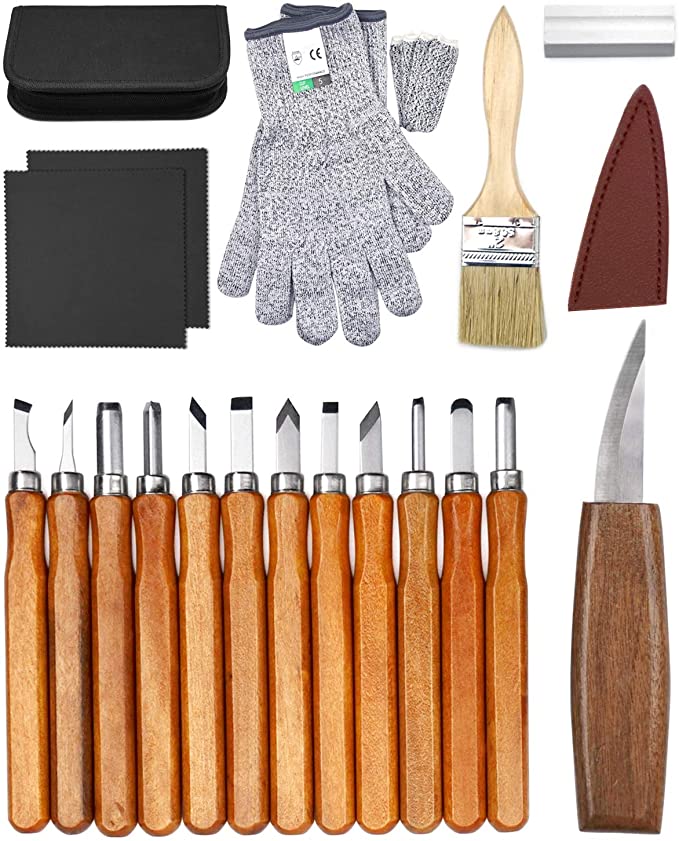
Wood carving tools with sharp edges will enhance your enjoyment. Here are common techniques for sharpening your wood carving tools. Sharp edges are also more durable and last longer than dull ones. Sharp edges make your tool easier to use. Sharp edges are easier to carve and provide the best cutting performance. Listed below are three common methods of sharpening wood carving tools. Learn more. - How to use a sharpening tool.
Sharp edges increase carving pleasure
Use razor-sharp tools for the best carving experience. Sharp tools are easier to use and allow for more control when carving. Also, the smooth surface of a sharply cut blade leaves a silky-smooth cut. For a successful carving job, sharp tools are vital. To achieve best results, you should sharpen your carving tools frequently. Regular sharpening will keep them sharp and make your carving work much easier.
Although sharp edges are a pleasure to carve, they can cause blisters. Wood's texture is natural and will not be smoothened with regular handling. Calhouns will develop from the blisters. However, this is a slow and painful process. If blisters are visible in your carving, you can change how you hold the tools. It may take some practice, but the effort will be well worth it.
Start by sharpening your knives with a sharpening tool and a fine-grained rock. Check for any damage to the edge. Chips along the edge will need to be ground more vigorously. A dull edge may require minimal grinding on a finer grade grit. Finally, you can test the knife with a piece of paper or rope. If the knife has been dull for a while, you may not have to use a sharpening stone.
Common techniques for sharpening wood carving tools
There are many options for sharpening wood carving instruments. There are oil stones, water stones, ceramic stones, and diamond sharpening stones. Oil stones need oil to be applied to the stone's surface in order to prevent metal particles embedding into the surface. For sharpening carbide-wood carving tools, ceramic and diamond stones do not require oil. This article will talk about the common methods of sharpening wooden carving tools.
A leather strop can be used to remove wire edges from blades and polish them. A leather strop can be used for any tool, but some carvers prefer a texture one. A flat leather strop is best for straight tools, or the outside edge gouges. If you're serious about your work, it might be worth investing in a leather strap with grooves.
Bench chisels have been sharpened traditionally at a 25-degree angle, with a secondary bevel of 5 degrees. Modern alloys can't be used with these angles and may break. As a result, you need to raise the angle of the bevel. This requires you to exert more force and will give you less control. The same goes for block planes. They are often sharpened at an angle of 20 degrees.
Use a sharpening tool
To sharpen wood carving tools, you can use a sharpening stone. A sharpening stone is made of grit, which is a mineral that has crystal form and is more durable than steel. Most stones will need a lubricant in order to cut properly and prevent metal particles from embedding into it. Sharpening your tool will make it easier for it to work with wood. The strop (often made of leather) is used to polish the edge, remove burr, and clean up the edges.

There are many kinds of sharpening stones on the market. There are oilstones (waterstones), ceramic stones, and others. Oil stones use oil as a liquid to keep fine metal particles and other contaminants from sinking into the stone. You don't need any lubricants for ceramic and diamond stone. They can both be used to sharpen carbide wood carving tools.
Sentima is a fine example of a quality sharpening tool. It comes in two sizes, a coarse one and a fine one. Both are made from corundum. This material is consistent in grain, which makes it easy to cut and gives it a smooth finish. Its unique design also makes it easy to clean. The sharpening system is made of durable materials and will last for years without degrading in quality.
FAQ
How can a beginning woodworker make a living?
Many people learn how to make furniture in order to set up an online business. There are other ways to make money if you're just starting out building furniture than selling on Etsy. You could also sell at craft fairs, or other local events. A workshop could also be offered for people who are interested to learn how they can build their own furniture. If you have experience as a carpenter or builder, you might consider offering services such as remodeling homes or creating custom pieces for clients.
This is a job that I can make a living from.
Yes! In fact, many woodworkers already do. According to the U.S. Bureau of Labor Statistics, the median annual woodworker wage was $34,000 in May 2012. This is more than the national average of 31,000 per annum.
Is it easy to start a woodworking business?
It can be difficult to start your woodworking business. There are lots of legal requirements and regulations that you'll need to follow. You don't have to go through all that hassle of setting it up. Many people choose to join existing businesses. This will allow you to avoid paying membership fees and taxes.
Where can I locate free woodworking plans
To find free woodworking plans, you don't have to buy any magazines or books. All you need to do is search Google. Search Google for "free woodworking" to see hundreds of sites that provide free plans.
You can learn how to woodwork.
Learning by doing is the best way of learning anything. Woodworking requires patience, practice and skill. Any craft requires patience to master.
The best way to learn how to do something is actually to do it. Start small, and work your way up from there.
Statistics
- The U.S. Bureau of Labor Statistics (BLS) estimates that the number of jobs for woodworkers will decline by 4% between 2019 and 2029. (indeed.com)
- Woodworkers on the lower end of that spectrum, the bottom 10% to be exact, make roughly $24,000 a year, while the top 10% makes $108,000. (zippia.com)
- Overall employment of woodworkers is projected to grow 8 percent from 2020 to 2030, about as fast as the average for all occupations. (bls.gov)
- If your lumber isn't as dry as you would like when you purchase it (over 22% in Glen Huey's opinion…probably over 10-15% in my opinion), then it's a good idea to let it acclimate to your workshop for a couple of weeks. (woodandshop.com)
External Links
How To
How to join hardwood without using nails
Woodworking is a popular hobby. You can make useful items from wood with your hands, which is both relaxing and fun. You may need to join two pieces without the use of nails. This article will teach you how to do this to keep your woodwork projects looking great.
The first thing you'll need to do is cut off any rough edges from your pieces of wood before joining them together. You don't want any sharp corners to cause problems later. Now you can start gluing the boards together.
If you are working with hardwood, only one side should be glue. For softwoods like cedar and pine, glue should be applied to both sides. After applying the glue, press the boards firmly until they are completely stuck together. Before moving onto the next step, make sure the glue has dried completely.
After you've glued your boards, you'll want to drill holes into the joints where you plan to insert screws. You can choose the type of screw to determine the size of your holes. For example, if you're going to use a 1/2-inch wood screw, then you should drill a hole that is at least 3/4 inches deep.
Once you have drilled the holes, the next step is to drive your screws through the joint into the board's backside. Don't hit the board's surface. You could damage the finish. Don't drive the screws too far into the end. This will avoid splitting in the wood's ends grain.
Protect your finished project now. You have two options: seal the whole furniture piece or just the top. You'll want a product that lasts for many years. There are many options: oil-based varnishes; polyurethane; shellac; lacquer.
These products can usually be found at any home improvement store. Just make sure that you buy the right kind for the job. Remember that some finishes can be toxic, so you should not use them indoors. Protective gear should always be worn when handling these finishes.